
作者:马扁
来源:原创
时间:2026-08-26
阅读:757351 次
倚天屠龙记吴启华版
2 sentenced in China’s first criminal case over leaks of unreleased Genshin Impact and miHoYo game content_我的网站

A |
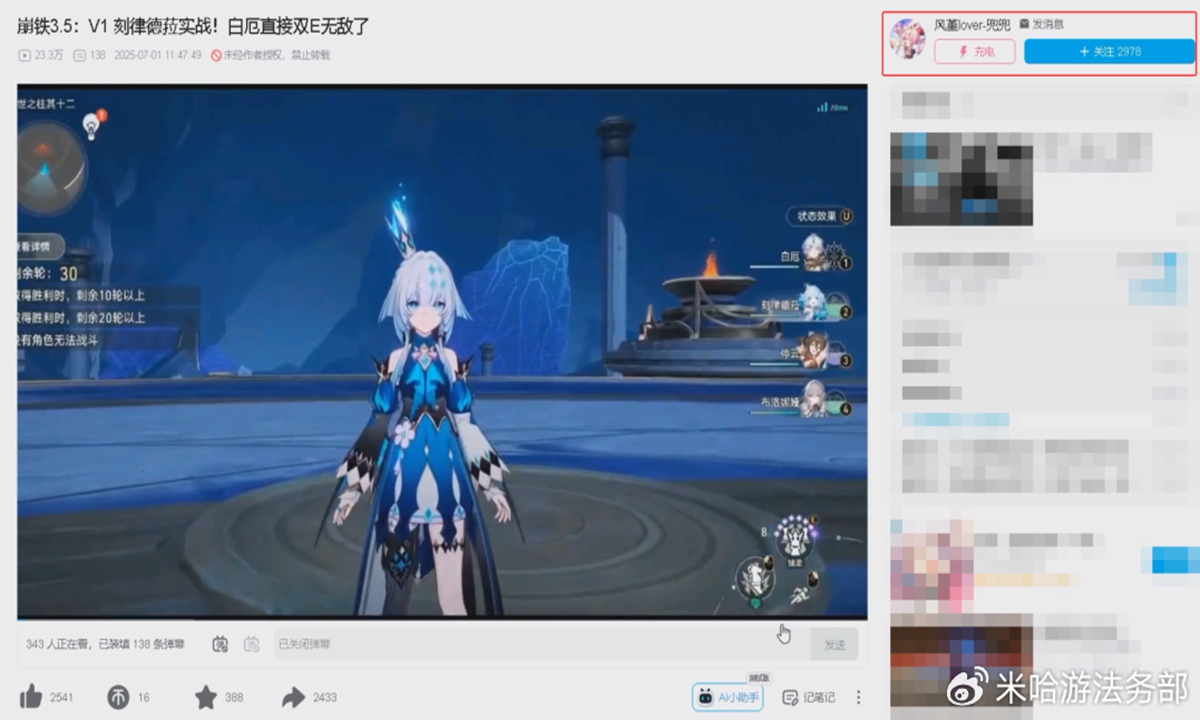
A criminal case involving information leaks related to miHoYo, the developer of Genshin Impact, has reached its first-instance verdict. Two Bilibili (Chinese video-sharing platform) users were found guilty of copyright infringement and were sentenced to one year and two months and one year in prison, respectively, both with probation. It is the first criminal game leak case under a new judicial interpretation issued by China's top judicial authorities, according to miHoYo.
The infringing videos uploaded by Su and Wu received more than 600,000 and 300,000 views, respectively, exceeding the criminal prosecution thresholds stipulated under the judicial interpretation. The court therefore found that the two individuals met the criteria for criminal prosecution and handed down guilty verdicts.
During routine monitoring, in July 2025, miHoYo discovered that Su and Wu had repeatedly uploaded gameplay videos featuring unreleased versions of miHoYo titles, including Genshin Impact, Honkai: Star Rail and Zenless Zone Zero, without any authorization from the company. The videos, widely circulated within gaming communities, exposed unreleased characters, skill animations and other content that had not yet been officially introduced to players, miHoYo noted.
After discovering the alleged violations, miHoYo reported the case to the police in accordance with legal procedures. Following an investigation, the police arrested the two individuals involved.
The case was publicly heard and the verdict was delivered on April 24, 2026. The court ruled that Su was to be sentenced to one year and two months in prison with probation, while Wu was sentenced to one year of detention with probation, according to miHoYo.
Guo Hao, a Beijing-based lawyer, told the Global Times on Thursday that a key significance of the case lies in its further clarification of how game leak cases can be assessed under the Criminal Law.
"In the past, game leaks were more often handled through civil infringement claims or breach-of-contract disputes. In this case, however, the court did not simply determine liability based on whether content was released ahead of schedule," Guo said. "Instead, it considered factors including the scale of dissemination, the nature of the leaked content and the impact caused, and determined that the conduct met the prosecution threshold for the crime of copyright infringement."
Similar game leak incidents have also occurred overseas in recent years. In October 2024, The Pokemon Company suffered a data breach that resulted in large amounts of internal information being leaked online, including employees' personal information, according to overseas media reports. Dubbed the "Teraleak" by the gaming community, the incident was reportedly one of the largest game-related leaks in recent years. The leaked materials reportedly included game source codes, details of future projects and other internal information, according to Nintendo Life, a UK-based gaming news outlet.
Earlier, Nintendo had pursued legal action over the leak of a Pokemon Sword and Shield strategy guide in 2019. According to gaming website Polygon, The Pokémon Company later reached a settlement with the two individuals responsible, who were required to pay $150,000 each in damages.
"From a player's perspective, there is a clear difference between game leaks and normal game discussions," Lu, a member from the Steam gaming community, told the Global Times on Thursday. "Players discussing and analyzing officially released information is part of gaming culture, but obtaining and spreading unreleased content through unauthorized channels can harm the efforts of developers and affect the experience of the entire player community."
Such concerns are also shared by game developers, who view unreleased content as a key part of their creative and commercial plans.
A post by miHoYo on its online account specifies that every unreleased frame of game content represents the design and refinement efforts of its creative teams, while also carrying players' expectations for upcoming updates. Unauthorized early exposure of such content not only infringes upon miHoYo's copyright interests, but also takes away the surprise that players should have when experiencing new content for the first time.
。 STOCKHOLM -- A ban on gasoline and diesel-fueled cars from a commercial district of Stockholm's downtown in 2025 will be the first for a European capital, a city official said Thursday.The ban will take effect in a 20-block area of shops, pedestrian walkways and a few homes in order to curb pollution, reduce noise and encourage use of electric vehicles said Lars Strömgren, the city council member for the Greens who's in charge of the Swedish capital's transportation. Many European capitals have restrictions on gasoline and diesel cars, but Strömgren says Stockholm’s complete ban would be a first. “We need to eliminate the harmful exhaust gases from (gasoline) and diesel cars. That’s why we are introducing the most ambitious low-emission zone to date,” Strömgren told The Associated Press. The idea is to create an "environmental zone” where only electric vehicles will be allowed. There will be some exceptions such as for emergency vehicles and transportation for the disabled.In its budget for 2024, the left-leaning, environmentally-focused city council on Tuesday unveiled the plan for the target area just north of the city’s famed Old Town. The municipal government controls a majority in the council, so the vote set for Nov. 23 is expected to be a formality. “We are pretty proud, I must say,” Strömgren said, adding that gradual expansion of the environmental zone would be decided in the first half of 2025.One of the city’s main cab companies, Taxi Stockholm, said its transition to emission-free vehicles is moving at a fast pace. The company’s acting chief executive Pernilla Samuelsson said it's emission-free vehicles now make up 30% of its fleet - almost seven times more than last year. “In other words, the transition is going fast and it is already being driven forward by the industry,” Samuelson said.Some aren't convinced things will go smoothly. Nike Örbrink from the opposition Christian Democrats told the Aftonbladet newspaper that some are concerned the plan would hurt businesses and the hotel industry.Other European capitals harbor similar ambitions. The Dutch capital, Amsterdam, is aiming for all transport in the city, including automobiles, to be emissions-free by 2030.The mayor of Paris wanted to ban all diesel cars before next year’s Olympics, and gasoline cars by 2030, but has run up against resistance.Currently, any diesel cars built before 2006 and gasoline cars built before 1997 are banned in Paris and 77 surrounding towns for 12 hours a day on weekdays. The ban will expand in 2025 for diesel cars built before 2011 and pre-2006 gasoline vehicles.___Jan Olsen reported from Copenhagen, Denmark. AP writers Mike Corder in Amsterdam, The Netherlands and Angela Charlton in Paris, France contributed.。
Current article:http://4z0.cuancuguanzhongnieqinyazhun.cyou/gr2xv/sr5.html
Published on:03:39:27


